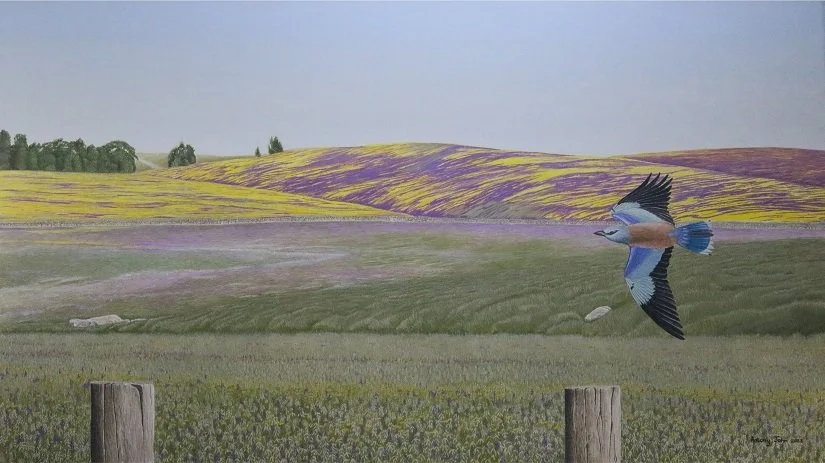
European Roller, Casevel 2025
18 x 32 in
acrylic on masonite
When I was growing up in Wales, I was enchanted by the exotic African migratory birds to mainland southern Europe. Birds like the Hoopoe, Bee-eater, Golden Oriole, and the spectacular European Roller, so named for it’s display flight as it tumbles through the air, highlighting its iridescent plumage. Alas, these birds never made it to Wales, so they remained as mythical birds in my imagination.
Many years later, I travelled to Portugal and spent 2 weeks in early April with a guide circumnavigating the country. Our first destination were the sweeping plains of Alentejo. Due to abundant rains, the vast open fields were awash with the colours of wildflowers such as Iberian Lavender, Yarrow, and Broom. It was against this surreal backdrop that I saw my first Roller, flying arrow straight in a gently rocking motion, it’s wings a kaleidoscope of turquoise, ultramarine, and cinnamon.
I had spent my adult life as an organic farmer, surrounded by the monotonous fields of monoculture and a conventional farming approach more aligned with a scorched earth policy than one of promoting biodiversity. The agricultural landscape of Portugal couldn’t have been more different, with it’s mixed use approach that left room for threatened species like the European Roller and the Great Bustard to co-exist with free ranging Pato Negro pigs which fed on acorns, cork oaks scattered across the fields, and olive trees mixed with vineyards. It was a landscape that hadn’t changed in probably 300 years, which is why these remarkable birds still fly there, now utilizing man made nest boxes, likewise the Kestrels that also fly the wide open pastures.